DLSS 4.5 & 6X Frame Gen: NVIDIA’s CES 2026 AI Revolution Redefines Game Visuals

With no new consumer GPUs announced at CES 2026, NVIDIA turned its focus to the software frontier, unveiling a monumental leap in its AI-powered gaming technology. The introduction of DLSS 4.5 and the next-generation Multi Frame Generation (MFG) 6X signals a pivotal shift: raw rasterization power is no longer the sole king. Instead, intelligent reconstruction and generation are set to deliver unprecedented image quality and performance stability, fundamentally changing what we expect from real-time graphics.
Illustrative image AI / HackStec
DLSS 4.5: Solving the Last Visual Puzzles
Positioned as the second generation of its transformer architecture model, DLSS 4.5 is not merely an incremental update. NVIDIA has trained this iteration specifically to tackle the most persistent and annoying visual artifacts that have lingered in upscaling technology, targeting what they term “edge cases” with aggressive AI training.
Key Visual Breakthroughs:
- The End of Shimmering: DLSS 4.5 introduces a major overhaul in temporal stability. This directly attacks the distracting flicker and oscillation (shimmering) seen on fine details like distant chain-link fences, grass, or static textures, especially during camera movement. Surfaces now hold their integrity.
- Ghosting Vanquished: One of the most criticized artifacts, ghosting—where fast-moving objects leave faint, trailing copies—has been drastically reduced. NVIDIA’s demos show near-elimination of these residual images behind swinging weapons, speeding cars, or character limbs.
- Enhanced Visual Fidelity: Beyond fixing flaws, DLSS 4.5 actively enhances certain elements. Early tests indicate more natural and robust particle effects (smoke, sparks) and improved handling of complex lighting scenarios, such as ray-traced global illumination and reflections, making them appear richer and less “processed.”
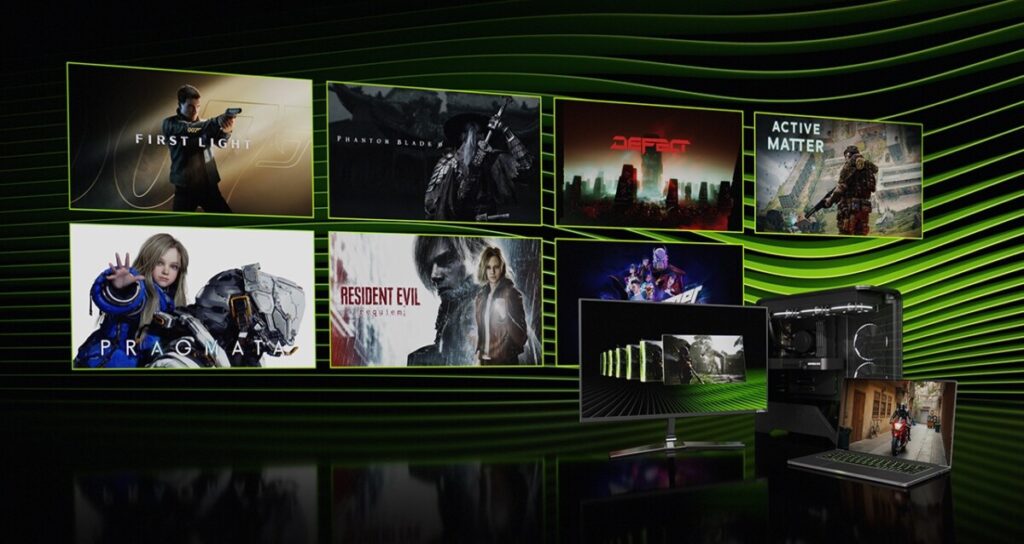
Image: Disclosure of NVIDIA
The Compatibility & Performance Calculus
In a strategic move for ecosystem longevity, DLSS 4.5 will remain compatible with GPUs as far back as the RTX 20 series. However, the performance story diverges based on hardware:
- RTX 40 & 50 Series: These cards leverage FP8 acceleration in their 4th and 5th Gen Tensor Cores. This dedicated hardware efficiently handles the increased computational demands of the new AI model, meaning users get the dramatic quality improvements with minimal to no performance cost—and often a net gain.
- RTX 20 & 30 Series: While compatible, these older architectures lack FP8 support. Running DLSS 4.5 may therefore involve a trade-off: a potential decrease in frame rate compared to DLSS 3 or 2 in exchange for the superior image quality. This allows users with older hardware to choose between maximum frames or the cleanest image.
NVIDIA will integrate version management directly into the NVIDIA App, allowing gamers to select their preferred DLSS model per game, balancing performance and fidelity to their personal preference.
Multi Frame Generation 6X & Dynamic Mode: The Latency-Aware Frame Pump
This is where the paradigm truly shifts. The new MFG technology moves beyond the current 4x multiplier to a staggering 6X Frame Generation. Conceptually, this means the AI can generate up to five entirely new frames between each single native frame rendered by the game engine.
The Dynamic Mode Game-Changer
The companion innovation is Dynamic Mode for MFG. This feature allows the NVIDIA App to set a target FPS (e.g., 360 FPS for a 360Hz monitor). The driver and AI then work in tandem to automatically adjust the frame generation multiplier in real-time, scaling between 2x, 3x, 4x, or the full 6x as needed to hit that target smoothly. It dynamically balances the load between the native render and the AI generation to maintain consistency.
Critical Hardware Context & The Latency Imperative:
It’s vital to understand that the expanded 6X multiplier and Dynamic Mode will be exclusive to the upcoming RTX 50 series (codenamed “Blackwell” gaming), with a launch window set for Q3 2026. This exclusivity is rooted in the need for a radically faster Optical Flow Accelerator and AI frame pipeline.
Why? Generating 5 frames from 1 exponentially increases the risk of input latency and visual discontinuity if the base performance isn’t exceptionally high. NVIDIA’s guidance is that MFG 6X is designed to extract the maximum from ultra-high refresh rate displays (360Hz, 480Hz, and beyond), but it requires a high native frame rate (ideally 90-100 FPS or more) as a starting point. This ensures the generated frames are spaced closely enough in time to keep system latency feeling responsive. It’s a technology for high-performance systems seeking to max out the most demanding monitors.
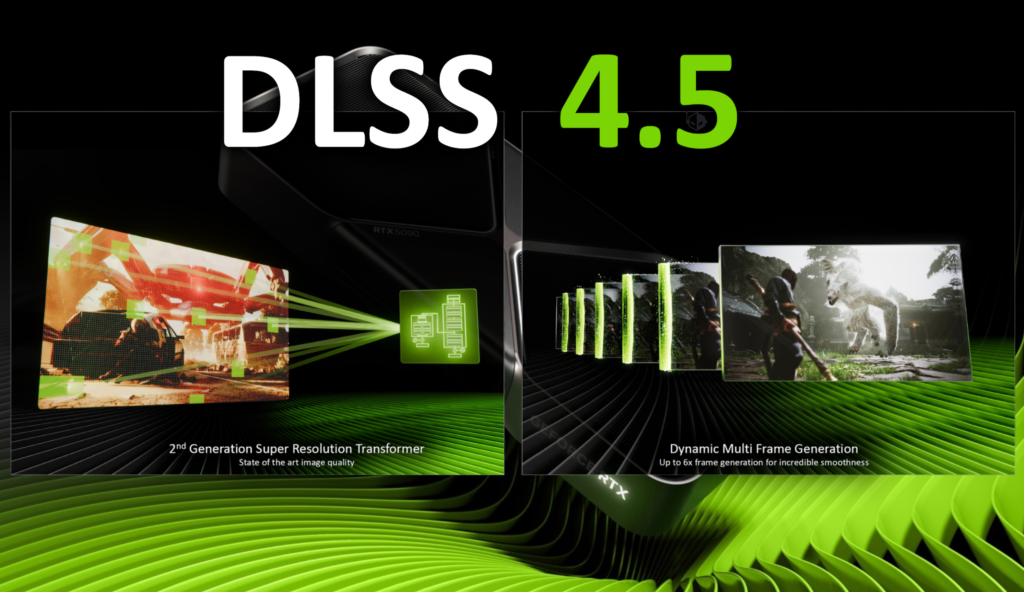
Image: wccftech.com
The Bottom Line: A Separation of Pathways
NVIDIA’s CES 2026 announcements clearly delineate two evolutionary paths for gamers:
- The Image Quality Path (DLSS 4.5): Available broadly, this is for everyone seeking a cleaner, more stable, and artifact-free image. It’s about perfecting the visual experience on existing hardware, with a smart quality/performance toggle for older GPU owners.
- The Hyper-Performance Path (MFG 6X): An exclusive, next-generation feature for RTX 50-series adopters targeting the pinnacle of high-FPS, high-refresh-rate competitive and immersive gameplay. It’s about AI-generated fluidity, intelligently managed to minimize latency penalties.
This strategic split allows NVIDIA to continue supporting its vast installed base while creating a compelling, software-driven reason to upgrade to its future architecture. The era of AI-driven graphics is no longer just about more frames—it’s about flawless frames and intelligent performance that adapts to your hardware and goals.
FAQ: NVIDIA’s DLSS 4.5 & MFG 6X
Q1: Will my RTX 3070 get DLSS 4.5?
A1: Yes, DLSS 4.5 will be compatible with your RTX 3070. However, because the RTX 30 series lacks FP8 Tensor Core acceleration, you may experience a slight performance decrease compared to using DLSS 3 or DLSS 2 to achieve the same output resolution. It becomes a choice between ultimate image quality or maximum frame rate.
Q2: What is the main benefit of MFG 6X’s Dynamic Mode?
A2: Dynamic Mode automatically manages the frame generation multiplier to maintain a user-set target FPS. This provides a consistently smooth experience, preventing frametime spikes and ensuring optimal utilization of high-refresh-rate monitors without manual tweaking.
Q3: Why is MFG 6X exclusive to RTX 50 series cards?
A3: The 6X multiplier requires a new, significantly more powerful Optical Flow Accelerator and AI frame pipeline to generate frames with extremely low latency. The RTX 50 series architecture is designed to handle this immense throughput while keeping input lag manageable, a task previous-generation hardware cannot perform effectively.
Q4: Can I use DLSS 4.5 and MFG 6X together?
A4: Absolutely. They are designed to work in tandem. DLSS 4.5 would perform the super-resolution upscaling from a lower base resolution, and MFG 6X would then generate additional frames from that already-enhanced output. This combo is how RTX 50-series users will achieve both stunning image quality and extremely high frame rates.
Q5: When will these technologies be available in games?
A5: DLSS 4.5 will likely begin rolling out to supported games in the coming months following its SDK release. MFG 6X with Dynamic Mode is slated for a launch alongside the first RTX 50-series gaming GPUs in Q3 2026, with game support following thereafter.






Publicar comentário